It is almost the ‘grab it off the shelf’ stock-phrase used when addressing a vegan. Where do you get your protein?
Why? My guess is that the meat and dairy industry have been drumming the protein campaign into society for so long, Chinese whispers began the idea protein could only be sourced from animals and so vegans will keel over in the street from lack of it…or something. Of course, like many things people tell us, this is just not true. Scientists and environmentalists, The UN, are all now urging us to look to plant sources of protein.
Most of the time when anyone raises this question it is highlighting a real concern from someone who is toying with the idea of dropping meat, and need to be sure it is right for them.
I hope this post is going to dispel any myths, give you a start point to begin your transition, and lead you to the most delicious meals and a body who thanks you for it.
Most of the time when anyone raises this question it is highlighting a real concern from someone who is toying with the idea of dropping meat, and need to be sure it is right for them.
I hope this post is going to dispel any myths, give you a start point to begin your transition, and lead you to the most delicious meals and a body who thanks you for it.
We are going to address;
what protein does,
where you can get it
the cost of plant-based protein vs. meat
what happens if you eat too much. I include a handy online calculator to determine if you are getting enough. I also reveal a ‘day in the life‘ and show you exactly what I ate in a day and the surprising results.
By the end of this article you will have all the information you need to know about protein, and where you can access extra info.
So firstly, lets find out…
what protein does,
where you can get it
the cost of plant-based protein vs. meat
what happens if you eat too much. I include a handy online calculator to determine if you are getting enough. I also reveal a ‘day in the life‘ and show you exactly what I ate in a day and the surprising results.
By the end of this article you will have all the information you need to know about protein, and where you can access extra info.
So firstly, lets find out…
What does protein do?
Proteins are made up of amino acids. Think of amino acids as the building blocks. There are 20 different amino acids that join together to make all types of protein. Some of these amino acids can’t be made by our bodies, so these are known as essential amino acids. It’s essential that our diet provide these.
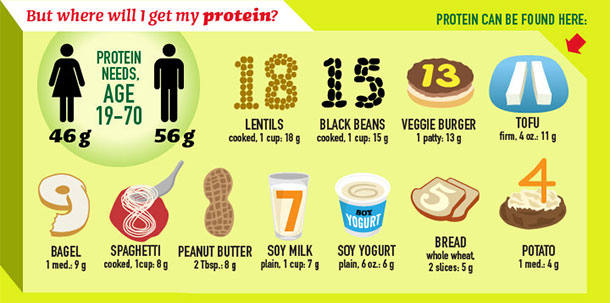
Recommendation for an adult male vegan - 56-70gms per day
Proteins are made up of amino acids. Think of amino acids as the building blocks. There are 20 different amino acids that join together to make all types of protein. Some of these amino acids can’t be made by our bodies, so these are known as essential amino acids. It’s essential that our diet provide these.
- Protein is necessary for the building and repair of body tissues.
- It produces enzymes, hormones, and other substances the body uses.
- It regulates body processes, such as water balancing, transporting nutrients, and
- making muscles contract.
- Protein keeps the body healthy by resisting diseases that are common to malnourished people.
- Prevents one from becoming easily fatigued by producing stamina and energy
How much protein do you need a day?
This is calculated according to age, gender, body size, physical activity, and health status.
The math is -
1. Weight in pounds divided by 2.2 = weight in kg
2. Weight in kg x 0.8-1.8 gm/kg = protein gm.
Use a lower number if you are in good health and are sedentary (i.e., 0.8). Use a higher number (between 1 and 1.8) if you are under stress, are pregnant, are recovering from an illness, or if you are involved in consistent and intense weight or endurance training.
Example: 154 lb male who is a regular exerciser and lifts weights
154 lbs/2.2 = 70kg
154 lbs/2.2 = 70kg
70kg x 1.5 = 105 gm protein/day
Here is a simple online protein calculator Recommended Protein Intake Calculator
As a guide -
Recommendation for an adult male vegan - 56-70gms per day
Recommendation for an adult female vegan - 46-58gms per day
Increased protein needs during pregnancy and breast-feeding are usually met by the extra calories from eating more food.Our protein needs can change dramatically when we’re injured or sick. They may double in the short term. The body gets this extra supply mostly from muscle, and it may take a month or more to restore the nutrients used up in the body while it fights off an infection or recovers from injury.
Because infants and children are growing, they need more protein than adults in proportion to their body weight. Children on a varied, balanced diet usually get enough protein as long as they are getting enough calories. That’s an important consideration for vegan children.
Where can you get your protein?
|
protein source
|
serving size
|
protein in grams
|
|
Tempeh
|
1 cup
|
41
|
|
Tofu, firm
|
4 ounces
|
11
|
|
Soybeans, cooked
|
1 cup
|
29
|
|
Lentils, cooked
|
1 cup
|
18
|
|
beans
|
1 cup
|
14-16
|
|
Chickpeas, cooked
|
1 cup
|
12
|
|
Peas, cooked
|
1 cup
|
9
|
|
Veggie burger
|
1 patty
|
13
|
|
Bagel
|
1 med.
(3 oz)
|
9
|
|
Quinoa, cooked
|
1 cup
|
9
|
|
peanut butter
|
2 Tbs
|
8
|
|
brown rice, cooked
|
1 cup
|
5
|
|
potato, cooked
|
1 med.(6 oz)
|
4
|
|
broccoli, cooked
|
1 cup
|
4
|
|
spinach, cooked
|
1 cup
|
5
|
|
almond milk
|
200 ml (glass)
|
1
|
|
goji berries
|
2 Tbsp
|
8
|
|
sunflower seeds
|
1/4 cup
|
6
|
|
chia
|
1 link
|
8
|
|
hemp seeds
|
1 cup
|
8
|
|
Almonds
|
1/4 cup
|
8
|
|
cashews
|
1/4 cup
|
5
|
|
mushrooms (portabella)
|
1 cup
|
2
|
|
corn pasta
Amaranth
avocado
carob flour
|
1 cup
1 cup
1 cup
1 cup
|
8
9
3
5
|
USDA Nutrient Database for Standard Reference, Release 18, 2005 and manufacturers’ information.
Broccoli provides the greatest amount of protein per calorie in comparison to beef. Green vegetables are rich in protein and relatively low in calories. They contain lots of vitamins and minerals too. Along with lots of fibre. As you can see, filling up with mostly plant based protein, and legumes is better for weight loss/management and health.
Do I have to eat protein with every meal?
You don’t have to have protein at every meal. The myth of eating ‘protein with a grain’ is that - a myth. It is what you eat throughout a day that counts.
Take a look at yourself: Do you look good, feel good, maintain optimum weight, and have good muscle tone? Does your hair and nails grow quickly? Do your wounds heal well? Are you generally healthy, and recover quickly from illness? If so, then we must be getting enough protein!
The results of my snapshot of one day of meals..
I journaled a day of my meals to see my level of protein intake, for that day. It was just a regular day, nothing fancy to eat. I choose to analyse the day before I wrote this article so I didn’t have any influence on the results.
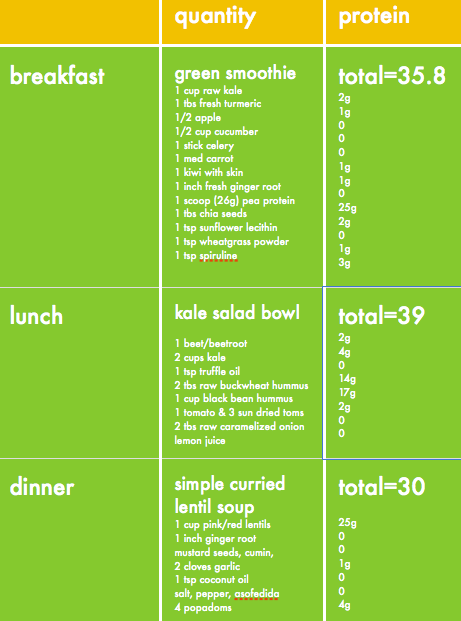
I used a really sII
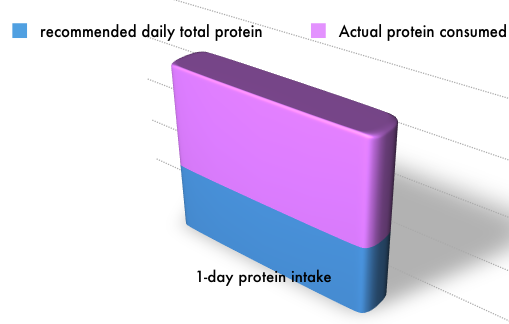
I was quite surprised by the results!
Obviously, I ate way too much protein today. But tomorrow, I may eat less. Actually, I am following a kind of zig zag or fill/hold back pattern to my eating. Not consciously, but I may feel hungry one day and not so much the next, so I may just juice later in the morning, skip lunch and have dinner, but only if I don’t feel hungry. If I am hungry, I eat. If I eat too much one meal, I’ll just skip a meal to even it out. Obviously, if I have eaten more than sufficiently then I don’t need to pile in more. After all the body gets overloaded and stress and it just gives you wind and makes you feel bad. Consequences=discipline!
Obviously, getting your main protein sources from nuts and seeds would overload your fat intake, so be sensible. For weight loss and maintenance eat mainly vegetables/legumes and just a handful of nuts/seeds a day.
Cost comparrison of vegan protein vs. meat
A friend of mine was asking about the cost differential of plant-based protein and meat. I knew from experience that eating a plant based diet was cheaper, but I’d never done any official comparisons.
I sourced costings online and completed a few calculations. Here is the cost per 100g of organic meat and legumes. I choose to look at chicken, beef & chickpeas. The findings of protein content differs in the chicken depending on whether it was enclosed in a small space in a factory (10-20g of protein) or allowed to roam (20-40g).
100g chicken = 20g of protein. Cost=£1.20
100g beef = 26g of protein. Cost=£1.50
100g chickpeas = 9g protein Cost= 26p
Vegan. Not only better for your body then! Plant-based protein is so much cheaper.
I then got all geeky and found a food carbon footprint calculator to determine the kg of C02 produced per 1 lb of production per product. I set them all to a 1400miles transport.
chicken = 1.5kg emissions per pound in weight
beef = 7.kg emissions per pound in weight
chickpeas = 0.4g emissions per pound in weight
Now, I am sure you do not need any more convincing! Lets talk eating!
A friend of mine was asking about the cost differential of plant-based protein and meat. I knew from experience that eating a plant based diet was cheaper, but I’d never done any official comparisons.
I sourced costings online and completed a few calculations. Here is the cost per 100g of organic meat and legumes. I choose to look at chicken, beef & chickpeas. The findings of protein content differs in the chicken depending on whether it was enclosed in a small space in a factory (10-20g of protein) or allowed to roam (20-40g).
100g chicken = 20g of protein. Cost=£1.20
100g beef = 26g of protein. Cost=£1.50
100g chickpeas = 9g protein Cost= 26p
Vegan. Not only better for your body then! Plant-based protein is so much cheaper.
I then got all geeky and found a food carbon footprint calculator to determine the kg of C02 produced per 1 lb of production per product. I set them all to a 1400miles transport.
chicken = 1.5kg emissions per pound in weight
beef = 7.kg emissions per pound in weight
chickpeas = 0.4g emissions per pound in weight
Now, I am sure you do not need any more convincing! Lets talk eating!
A few suggestions for some delcious protein-rich meals:
Breakfast
buckwheat pancakes
over night gluten free oats
Dessert
Basically, get the protein grammage in your mind for your staples, be they; Amaranth, kale, spinach, avocado, tempeh (fermented so healthier than tofu), nuts, legumes, potatoes, rice, buckwheat,mushrooms, or whatever, then just do a quick sum in your head and approximate. No one wants to have to get the calculator out every time they eat, do they? One to two cups of beans or a protein packed superfood - quinoa or amaranth for example, a day, perhaps a small handful of nuts/seeds, and lots of greens should be about right.
 |
| from www.purelifenutrimedics.com |
Remember, guidelines are based on your levels of activity, age, stress, etc so do use the calculator and adjust to your life situation. But rest assured, being vegetarian or vegan, if you are eating a wide variety of whole foods you are doing A ok.
Now I have actually calculated my intake I can 100% feel confident about my diet. So when anyone asks ‘are you getting enough protein?’, I can smile and say…YES!
Now I have actually calculated my intake I can 100% feel confident about my diet. So when anyone asks ‘are you getting enough protein?’, I can smile and say…YES!
What happens if you eat too much?
Some researchers say it excess protein is just taken away as waste, some say it negatively
impacts the liver and kidneys if you are consuming too much animal protein. Cited as
follows;
The high-protein diet of meat eaters robs their body of calcium, as cited by Dr. Neil Nedley,
MD, author of “Proof Positive (How to Reliably Combat Disease and Achieve Optimal Health
through Nutrition and Lifestyle).” He wrote that research evidence has indicated that an
evidence has indicated that an excessive diet of animal protein increases the risk of osteoporosis. “Study after study indicate
that eating meat can cause a loss of calcium from the body. Research done at the University
of Wisconsin illustrated particularly well the harmful effects of excess protein.”
Studies of Linkswiller and associates in 1981 involving three groups showed that the high
protein intake group lost calcium every day simply because of their high protein consumption.
The excessive protein was leeching calcium from their bones even though they were getting
plenty of calcium in their diet.
Dr. CM Weaver and Associates at Purdue University also cited in their study that humans
absorb as much or more of the calcium in plant products than they do from milk (sourced from animals). The group’s study also revealed that although milk has a high calcium content, 60
to 80 percent of it is not absorbed through the human intestine.
Stronger bones
Pitchford cited further reasons vegetarians have stronger bones and fewer calcium
deficiencies in general:
• The digestion of meat results in acids must be neutralized by calcium and other alkaline
minerals.
• Flesh protein contributes to a phosphorus/calcium ratio in Americans four times greater
than desirable.
SOURCES
Organic Authority
Low Carb Diets
USDA
Nutrition Data






Wow I’ve only just come across your article now! I am neither vegan nor vegetarian. However, I don’t eat red meat. I usually get my protein from chicken and fish… and of course veg. I’m a powerlifter/muscle builder, so I do need more protein than the average person (and a certain quality) in order to repair muscle. Your article is the first I’ve ever come across written by a vegan that is sound! I’m so glad I found your blog! I’ve been struggling to find protein powders in Buenos Aires that are PLANT BASED and don’t have a ridiculous amount of ingredients in them (like aspartame and other unnatural things!) I was so happy to read that there is pea powder (from one of your other posts) here! YAY!! Sometimes, a post workout shake is the quickest and easiest way to get protein to my muscles. Thanks so much for your article. I’ll be sure to keep following your entries.
@Alma\
Hello Alma! So nice to hear from you. I’m glad you found my article useful. The fact really does seem to be that if anyone eats enough food they will be getting enough protein. I’ve not heard from a body builder before though. Yes, it is frustrating when ‘healthy’ protein powders are full of dextrose, sweeteners or the like. There are MANY vegan body builders online you can find, I’m sure they’d help you if you asked. Good luck! India